Showing posts with label pressure. Show all posts

Wednesday, December 1, 2010

Dear Dr. Scarpetta...

I think that that woman could be the only person on earth who has put up with so many psychopaths breaking into her house at night.

Kay Scarpetta in the medical examiner (yes, a coroner) in Richmond, Virginia in Patricia Cornwell's mystery novels. With her detective "buddy" Marino, they're basically the average pair of people who solve crimes like in any other mystery novel.
What I like about Cornwell's books though are that you get to actually see into Kay's real life, a.k.a, her life at home, not just her bloody life at the morgue and with her jack*** of a commissioner named Amburgey. She actually has real feelings! (Unlike some un-blogging worthy books I've read).
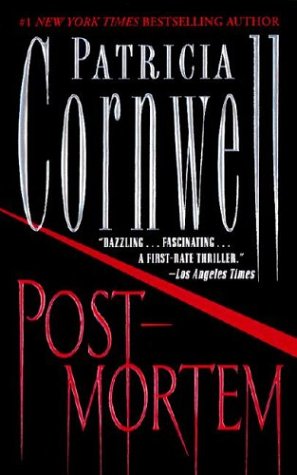
Kay has a weird way to relieve her stress from work. Who wouldn't? I think that you need a little more than yoga or getting drunk to help yourself feel better when you're getting stalked by a guy who's planning to trick you then stab you or strangle you and rape you like he did to 5 other women.
So, Kay relieves herself by cooking Italian food. It's like a little blanket that she hides under from the rest of the world. After a hard day at work she goes home, drinks some liquor, and prepares to go to bed.
I always will wonder when she realizes that making food and drinking alcohol won't help anything, especially since she always happens to it a few days before or the very day that the person who killed everybody else tries to kill her, too.
I think that maybe for some people who hide from the world like Kay have a thick, tight warm blanket around them, but sometimes the blankets have small holes or tears that make the people inside them feel insecure. We all fell insecure, but when you've been in a cocoon for a while, you sort of get used to the dark. Then, when you see the outside world, you're frozen like a deer in headlights because you're so used to seeing the world from the inside of a safe little shell. As tempting as it may be to be addicted to the darkness and not want to see the reality side of things, you always should. If you don't, you're living your whole life in isolation. You're ignoring the world and what it has to offer. And maybe when the opportunity of a lifetime comes along, you'll be hiding. You won't even be there to miss it.

But keep it up, Scarpetta!
KEEP FIGHTING THE EVIL FORCES

Saturday, November 20, 2010

Research Entry #2

  • "Students who describe themselves as lesbian, gay, bisexual or transgendered are five times more likely to miss school because of feeling unsafe. 28% are forced to drop out. --National Gay and Lesbian Task Force, "Anti-Gay/Lesbian Victimization," New York, 1984.
  • The vast majority of victims of anti-lesbian/gay violence - possibly more than 80% - never report the incident, often due to fear of being "outed." --New York Gay and Lesbian Anti-Violence Project Annual Report, 1996.
  • Due to sexual orientation discrimination, lesbians earn up to 14% less than their heterosexual female peers with similar jobs, education, age and residence, according to a study by the University of Maryland. --Badgett, M.V. Lee, "The Wage Effects of Sexual Orientation Discrimination," Industrial and Labor Relations Review, July 1995.
  • 42% of homeless youth identify as lesbian, gay or bisexual. --Orion Center, Survey of Street Youth, Seattle, WA: Orion Center, 1986.
  • More than 84% of Americans oppose employment discrimination on the basis of sexual orientation. --Survey Conducted by Newsweek, January 1997.
  • 75% of people committing hate crimes are under age 30 - one in three are under 18 - and some of the most pervasive anti-gay violence occurs in schools. --New York Gay and Lesbian Anti-Violence Report, 1996.
  • Lesbian, gay and bisexual youth are at a four times higher risk for suicide than their straight peers. --Gibson P., LCSW, "Gay Male and Lesbian Youth Suicide," Report of the Secretary's Task Force on Youth Suicide, U.S. Department of Health and Human Services, 1989.
  • A survey of 191 employers revealed that 18% would fire, 27% would refuse to hire and 26% would refuse to promote a person they perceived to be lesbian, gay or bisexual. --Schatz and O'Hanlan, "Anti-Gay Discrimination in Medicine: Results of a National Survey of Lesbian, Gay and Bisexual Physicians," San Francisco, 1994."
cite: http://www.now.org/issues/lgbi/stats.html
(And all other links).

It really shocks me how much being gay or lesbian can affect your life. It can ruin or give you a detriment on your career, get you bullied in high school, and even make you drop out. So many gays or lesbians commit suicide, or have hate crimes committed toward them. How would it feel to have someone who was homophobic treat you as if you were a different species?
I think that this would be a good topic to write about, because it really shows kids that no matter who you are, you should still be able to live a happy life and be treated as equally as others.

Wednesday, November 10, 2010

A Bird Cries, A Damsel Sighs...

When Art Spiegelman wrote the life-changing graphic novel, MAUS, he wrote about anything but a fairy tale. Portraying the characters as different animals, Spiegelman tells the story of his father's experience in the Holocaust.
Right away, I saw a connection between this book and Terrible Things. Not only are they both stories of the Holocaust, but both show the characters as animals, but I think that they both did so for different reasons. Eve Bunting, the author of Terrible Things, had different animals being discriminated against to show the reader the ridiculous things that people in real life discriminate against, and how differences don't matter.
In MAUS, I think that Spiegelman did something very clever with which people from the Holocaust he put as each animal. Spiegelman, his father, his family, and all the rest of the Jews are drawn as mice. Later when he draws the Nazis, if you look closely, you'll notice that they're cats. This says a lot about what happened in the Holocaust. The Nazis and Jews were just like cats and mice: cats hunt mice, and unlike in Tom & Jerry, the cats win the fight in real life. They mice are their prey, small, weak, and helpless. But cats seem like lovable, friendly creatures, a companion, a pet. But to most people, mice, rats, or just all rodents in general, are rabid, nasty, garbage hoarding, dirty, foul beasts, and that's exactly what the real Nazis in the Holocaust thought about the Jews, although the Jews were innocent victims of their power. But the real-life version is the cat is the exact opposite of what the Jews thought of the Nazis. To the Jews, Nazis were killers, liars, men to be feared.
The fact that sometimes animals like mice or rats, playing a human role or not, can be misunderstood, relates back to an entry way back on this blog. This particular entry was about Templeton. Remember him? The rat from Charlotte's Web? I don't think that I'll ever let the idea that he's the real victim of discrimination in Charlotte's Web leave my cerebrum. Throughout the whole book he was described as a nasty, mean and dirty. I find that not only were the animals in the barn discriminatory toward Templeton, but also E.B. White!

1rat noun \ˈrat\

1
a : any of numerous rodents (Rattus and related genera) differing from the related mice especially by considerably larger size

1mouse noun \ˈmas

: any of numerous small rodents (as of the genus Mus) with pointed snout, rather small ears, elongated body, and slender tail

I wonder why people think that rats or mice are such abd creatures. Is it because they've had to adapt to be dirty or live in subways because of what us humans have done to the world? Modernization, construction, pollution....what could have made the difference?

Friday, November 5, 2010

Equality, And I Will Be Free.

Equality

You declare you see me dimly
through a glass which will not shine,
though I stand before you boldly,
trim in rank and making time.


You do own to hear me faintly
as a whisper out of range,
while my drums beat out the message
and the rhythms never change.


Equality, and I will be free.


You announce my ways are wanton,
that I fly from man to man,
but if I'm just a shadow to you,
could you ever understand?


We have lived a painful history,
we know the shameful past,
but I keep on marching forward,
and you keep on coming last.


Equality, and I will be free.


Take the blinders from your vision,
take the padding from your ears,
and confess you've heard me crying,
and admit you've seen my tears.


Hear the tempo so compelling,
hear the blood throb through my veins.
Yes, my drums are beating nightly,
and the rhythms never change.


Equality, and I will be free.
-Maya Angelou

The first time I read this, I thought about African Americans, and how there was so much segregation in the United States involving them and whites. It all seems so long ago, but there was still segregation in the US when your grandparents were alive, maybe even your parents. I decided that the poem talked about how the African Americans were fighting for equality and acceptance in society when there was segregation. Maya Angelou is speaking to the white people that aren't accepting. She speaks of their ignorance toward her race, how they know that there should be equality and that they know African Americans wish for it, but don't want to stand up and take action against segregation.
This reminded me of the children's book that we read recently in class called Terrible Things, by Eve Bunting. It's an allegory of the Holocaust, and takes place in a quiet forest, until the "terrible things", which represent Nazis, come and start to take animals that have certain features away. When the terrible things wanted animals with quills, they take porcupines. When they wanted animals that swim, they take the frogs and fish. And each time an animal is taken away, the rest speak badly about it, even if they were friendly before they got taken by the terrible things. In the end, the last survivor thinks, "I wish that I could have stood up against the terrible things."
I think that this moral relates to the poem Equality, because it teaches readers to stand up against people, or even "things", that aren't doing the right thing. The poem teaches readers not to take ignorance as an answer, and to always fight for what you beleive in, which in both cases is equality, for all different types of people or animals, and the African Americans and the whites during segregation.
Another childhood book that the poem Equality relates to is Horton Hears A Who. Horton Hears A Who is about an elephant and his companions that are so small they live on a speck of dust. Others in the forest think that his friends are non-existent. In order to prove that they are real, the beings that live on the speck of dust gather together to make a loud enough noise so that the animals in the forest can hear it. All the villagers beat their drums and shout and scream and blow their whistles and play their loudest instruments. Still, the noise is not loud enough. The mayor runs all around town, in search of one more villager. Finally, he finds one: a little boy named Jojo. When this boy yelps, he makes the noise loud enough for the animals in the forest to hear, and finally their voices are heard, the animals in the forest accept them for who they are, despite their shock that such a small creature could even exist, on a piece of dust no less!
All three authors are telling the reader the same thing: Stand up for what you beleive in, because without a person that's willing to speak their mind toward a person who's doing the wrong thing, their voice will never be heard.

Thursday, October 28, 2010

Stereotypes

All women
Are skinny And weak
And have long hair
And pretty
And have children
All men
Are muscular
And strong
and handsome
And have short hair
And have children
Women do chores
And men go to work
Women like men
Men like women

All one society
A "perfect" society.

1per·fect, adj \ˈpər-fikt\

a : being entirely without fault or defect : flawless

This is not perfect.

Tuesday, October 26, 2010

Mother to Son

"Well, son, I'll tell you:
Life for me ain't been no crystal stair.
It's had tacks in it,
And splinters,
And boards torn up,
And places with no carpet on the floor—
Bare.
But all the time
I'se been a-climbin' on,
And reachin' landin's,
And turnin' corners,
And sometimes goin' in the dark
Where there ain't been no light.
So, boy, don't you turn back.
Don't you set down on the steps.
'Cause you finds it's kinder hard.
Don't you fall now—
For I'se still goin', honey,
I'se still climbin',
And life for me ain't been no crystal stair."
-Langston Hughes (1902-1967)

In the poem "Mother to Son" by Langston Hughes, Langston takes the role of a mother, speaking to her son about what her life has been like and the troubles that she's been through. The poem acts as a kind of motivational speech to the son, telling him, "Don't you set down on the steps, 'Cause you finds it kinder hard." The mother is telling the son not to give up because life get's hard, and that he's not climbing a crystal stair, like some people.
The crystal stair in the poem represents perfection, and how not all people get to live the kind of life where everything is perfect. The mother, speaking to the son, is telling him about all the difficulties that she's had in life. A splinter, a tack, cold, bare floors or torn up stair boards. Some things hurt for a minute, like a splinter, but some leave bruises for days, or even scars and cuts.
The time period in which the poem was written (1922, around the time of the Great Depression and when African Americans didn't have as many rights as they do today and were discriminated against) also relates to the theme of not giving up because of bumps in the road like in "Mother to Son".
Even 41 years later, there were still issues with discrimination against African Americans.
On August 28th, 1963, Martin Luther King Jr. said:
"...We must face the tragic fact that the Negro is still not free. One hundred years later, the life of the Negro is still sadly crippled by the manacles of segregation and the chains of discrimination. One hundred years later, the Negro lives on a lonely island of poverty in the midst of a vast ocean of material prosperity. One hundred years later, the Negro is still languishing in the corners of American society and finds himself an exile in his own land."
In the poem "Mother to Son" by Langston Hughes, not only does the son represent a literal son, whose mother is telling him valuable information that he'll use throughout his life, the son also symbolizes the whole entire African American population in the United States in 1922, and Hughes is telling them not to let a ripped up floor board, or being tired of climbing, stop them from reaching their ultimate goal: equality.

Sunday, October 24, 2010

Social Awareness Journal - Day 5

Day 5
Wednesday, October 27th, 2010
Abortion: Pro-life, or Pro-Choice?

"Abortion: the termination of a pregnancy after, accompanied by, resulting in, or closely followed by the death of the embryo or fetus"

"There are two many answers to the question of abortion access. They can be grouped into two basic positions:

Those promoting a pro-life or anti-abortion position say that the government should override a woman's decision to have an abortion in some, many, or all cases, and require her to continue her pregnancy to childbirth.

Most pro-lifers base their stance on the belief that human life, in the form of an ovum and spermatozoon, becomes a human person during the process of conception. Thus, a human pre-embryo, embryo and fetus are all persons entitled to fundamental human rights, including the most basic right: to be allowed to live. The lives of two humans are being considered here: that of the woman and her the life of the pre-embryo, embryo, or fetus.
Those promoting a pro-life or anti-abortion position say that the government should override a woman's decision to have an abortion in some, many, or all cases, and require her to continue her pregnancy to childbirth.

Most pro-lifers base their stance on the belief that human life, in the form of an ovum and spermatozoon, becomes a human person during the process of conception. Thus, a human pre-embryo, embryo and fetus are all persons entitled to fundamental human rights, including the most basic right: to be allowed to live. The lives of two humans are being considered here: that of the woman and her the life of the pre-embryo, embryo, or fetus.

Those promoting a pro-choice position
say that the government should not interfere with the woman's decision, or should do so only under very rare circumstances. She should be able to have an abortion in many, most or all cases.

Most pro-choicers base their stance on the belief that human life becomes a human person at some time after conception -- perhaps when the embryo's heart starts beating, or when the fetus first looks human, or it becomes sentient, or it has half emerged from its mother's body, or is born, or is severed from its mother and is functioning independently. They feel that a woman should not be forced to go through a pregnancy and childbirth if she does not choose to do so. She should be allowed to have an abortion if it is done before her embryo or fetus attains personhood."

Abortion has become a major way for people of different opinions to clash. As you read in the article above (cited below), there are two different point of views on abortion. I, myself, am a pro-choicer, because I beleive that a woman has the right to do what she wants to do with her own body. But, at the same time, pro-lifers beleive that a baby, even as a fetus, is still living and deserves a chance at life. Pro-lifers think that no woman should have an abortion.

www.m-w.com
http://www.religioustolerance.org/abofund.htm

Social Awareness Journal - Days 3 and 4

Day 3
Sunday, October 24th, 2010
Poverty, And Its Effects On People Worldwide

What is poverty, anyway? Poverty is "the state of having little or no money and few or no material possessions". While many people around the world can afford everyday expenses such as food or clothing, 97 million of the 471 million people living in Eastern Europe and Central Asia live on less than 2 dollars a day. Also of those 471 million, 24 million live on less than 1 dollar a day. Nearly 50 percent of sub-Saharan Africans live on less than $1 a day, and the number of people in South Asia who live on less than 1 dollar a day reaches almost half a billion. In South Asia, 240 million people don't have access to safe water, and half a billion don't have proper sanitation.
The poverty rates don't even end there. There are tons of families, children, and adults living in poverty in the United States. In fact, 37 million Americans are living in poverty, and nearly 35% of the poorer population in the US is children. The ratio of children who live in poverty in the US, is 1 to 6.

The fact that there are so many people who live in poverty around the world is so depressing. Here I am, typing this on a computer, in my own room, in my own house, with my own family, who makes an average amount of money each year. We're certainly not in poverty, but we're not rich, either. And the funny thing is that I never really remember thanking anybody for what I have. I know that on my birthdays, when people give me gifts, I say thank you. I say thank you when I get presents on the winter holidays. But have I ever thanked anyone for what me or my family has? Or what we don't have?

Day 4
Monday, October 25th, 2010
Sexism...

sex·ism - noun \ˈsek-ˌsi-zəm\: prejudice or discrimination based on sex; especially: discrimination against women
2: behavior, conditions, or attitudes that foster stereotypes of social roles based on sex
Sexism exists. As you read above, sexism
is the belief or attitude that one gender is inferior to, or less valuable than the other.
Sexist statements include things like, "women can not play sports such as football or 'fight'" or "men can not go to salons or get their nails done". These statements discriminate against certain genders; male, or female. "But what's wrong with sexism?" someone might ask. To be short, sexism is just another form of any other kind of discrimination, no worse than racism or other types.

Just like what I said on my point of views of gay suicides and the people who bully people who are gay, I just don't understand it. And I don't understand this. Why would someone feel that they're more superior to someone else just because of their gender? I appreciate women who stand up against sexism toward women (although there is sexism against men, as well). I especially love feminist artists, and how they express their ideas about sexism and feminism in their artwork. It says a lot about how some people in our society today think about sexism.
I'd like to give a shout out to Kiki Smith, my favorite feminist artist, as of...yesterday. ;)

Cite: wordnetweb.princeton.edu/perl/webwn
http://www.npc.umich.edu/poverty/
globalissues.org
http://www.nccp.org/topics/childpoverty.html
thinkquest.org
savethechildren.org

Social Awareness Journal - Days 1 and 2

Day 1
Friday, October 22nd, 2010
Gay Suicides - The Pressure that Society Puts on People Who are Gay

Recently, whether you read it in a newspaper or heard it on the news, you've probably heard about Tyler Clementi's suicide. Tyler Clementi was an 18-year-old gay freshman at Rutger's University, who committed suicide by jumping off the George Washington Bridge on September 22nd. Clementi committed suicide after some of his classmates posted footage of him having a sexual encounter with another man. People were shocked, and still are, by his suicide. What some people aren't aware of though, is that Clementi's suicide is just one of many that have been committed over past few months. On September 9th, 15-year-old Billy Lucas hanged himself "[after] what classmates reportedly called a constant stream of invective against him at school."
Then, just a little less than 2 weeks later, 13-year-old Asher Brown shot himself after he told people that he was gay. And, around a month ago, another 13-year-old named Seth Walsh hanged himself, after being "apparently unable to bear a relentless barrage of taunting, bullying and other abuse at the hands of his peers."

My reaction to this? What has the human race become? Who are we to make fun of, and put down, other people because of their sexual orientation? What's the motivation? Or satisfaction? Why do people think that it's okay to push people's emotional limits, so much, and so far, that they commit suicide? That they take their own life, because they're not "socially acceptable"? Think about that.

Day 2
Saturday, October 23rd, 2010
Injustice: What it Means To Be Small, Be Susceptible, Be an Animal

Have you ever seen commercials on television about how many animals are abused each year? What about the ones that tell you how many animals are put in shelters, how many are used for fur, or how many are used for testing make up products or drugs ? In case you haven't, or you've forgotten the number, I'll tell you. Millions of animals are abused each year. Approximately 6-8 million dogs and cats in the United States are put in animal shelters, and of those 6-8 million, approximately 3-4 million are euthanized. In 2006, more than 350,000 baby seals were killed for fur, including more than 30 million mink, foxes, chinchillas, and other animals that are killed on fur farms each year, by electrocution and poisoning, as well as approximately 2 million dogs and cats worth of fur that's exported from places worldwide, and mostly labeled as fake here in the United States, also unaware that some of these 2 million are skinned alive.
In animal testing, approximately 25 million vertebrate animals are tested in the United States every year. If you include invertebrate, the number goes up to 100 million.

The thing that disturbs me the most about how many animals are abused or put in shelters every year, just in the United States, is that so few people actually know about it. Yes, we all know that animals are abused and put in shelters, and that some are killed for fur or testing, but people never really tend to look at the number. I can compare it to an ordinary person: they find a fatty snack that they really like, but never bother to look at the nutrition facts, and eat it almost every day. Over time, they get more and more obese, but they never notice. Then, one day, bam! They look at the scale, and their whole situation just blows up in their face. It's the same this. People never really look between the lines so see the facts that they're missing, and then, all of a sudden, they realize what's wrong, just when it's too late. What's going to happen when the animals that humans hunt become extinct? Or shelters are overridden with animals? Or, no animals are even left?

Tuesday, September 28, 2010

A Small Cliche Fantasy Story

If I hadn't reread Charlotte's Web, taken notes, thought about it thoroughly, and written numerous entries on it, if someone asked me what I thought it was about, I probably would have said that it was a small cliche fantasy story that involved a pig and his best friend named Charlotte.
Although it does have the occasional cliche moral or theme (i.e. don't judge a book by it's cover, friendship), how I look at Charlotte's Web now is the complete opposite of how I thought about it before...starting with who I think is the most misunderstood character in this book: Templeton.
At first, Templeton doesn't play much of a big role in Wilbur's life. Toward the end and a little bit toward the middle, he helps save it.
That's exactly what bothers me about Templeton and Wilbur's relationship. While Charlotte thanks Templeton for going out to the dump for Wilbur's benefit, Wilbur doesn't really acknowledge Templeton at all, or the fact that without him, Charlotte would run out of words to write on her web. And without new words on her web, Wilbur is basically asking to become Zuckerman's bacon supply.
Not only does Templeton help Wilbur by collecting scraps of writing at the dump, he bit Wilbur's tail to make him wake up after he fainted at the fair. And still, Templeton doesn't even get the slightest hint at a thank you from Wilbur. All Wilbur wants is more.
Finally, Templeton stands up for himself when Wilbur wants him to get Charlotte's egg sack to bring back to the barn.
"Who made trip after trip to the dump? Why, it was old Templeton. Who saved Charlotte's life by scaring that Arable boy away with that rotten goose egg? Bless my soul, I beleive it was old Templeton. Who bit your tail and got you back on your feet this morning after you fainted in front of the crowd? Old Templeton. Has it ever occurred to you that I'm sick of running around and doing favors?"
I totally get and agree with what Templeton is saying. If you or I did numerous favors for someone, I think that we would both expect that that person at least gave us a thank you, or a small favor back.
But in truth, Wilbur never really thanked Templeton for anything that he did in Wilbur's favor. All Wilbur did to make Templeton happy is give him food, but I think he deserves a real thank you, not bribery.
I think the quote above is meant to make Templeton look like the "bad guy". In fact, that's what I thought when I first read it. But now, I think that Wilbur is such a stuck up brat. He says to Templeton, "Stop acting like a spoiled child!", when in reality, Wilbur is the spoiled child. He asks favors from other people without giving them a thank you, and has had people like Fern and Charlotte care and nurture him his whole life. He doesn't understand Templeton's point of view at all.
I also think Wilbur is hypocritical. When he's up at night in one of the chapters, he looks down on Templeton for being up late chewing on things, which is what a rat does, when he himself is up late as well. This is another example of Wilbur not understanding Templeton's point of view. Being up late and chewing is an instinct for rats, not pigs.
I think that even though Templeton is mainly portrayed as a bad character, Wilbur could not have survived without him and that Wilbur is ignorant and unaware for not realizing this.
I wish I could say that I thought Wilbur was a character who was caring and understanding for others, but I would be lying. Wilbur never really showed understanding or gratefulness toward Templeton...the rat he should be thanking for helping him stay alive to see the spring once more.

Thursday, January 28, 2010

The Truth About Forever

This was one of my favorite reads in a while: Not to easy and not too hard. It also made me think about the relationships between parents and their children (or child). Like for example, what a parent wants for their child is sometimes the complete opposite of what the child wants for themselves. Should parents have control over every single thing that their kids do? Or do children get a say?
Macy is starting to think about these ideas after her super-uptight boyfriend Jason goes away to a learning camp - and Macy is left behind with her even more uptight mother for the summer. She and her mother get into serious disagreements, though. Macy just wants to be normal: to be able to go out with friends and go to parties, instead of just being referred to as "the girl who's dad died" or things like that. Her mother, on the other hand, wants to turn 180 degrees from that thought. Macy's mother wants her to be prim and proper, and always do what she tells Macy to do. Throughout the whole book I just want to scream, "Let Macy have freedom already!!"

When Macy finally finds some friends by joining a catering business, things begin to look up. Except for the fact that her mother disapproves her new friends, and limits the time she spends with them. I understand why she would want to do that (one of Macy’s new friends has gone to jail), but does she really have the power to "disapprove" of her daughter's friends?

Macy has other problems, though. Like with her boyfriend, Jason. When Kristy (a friend) tries to see deeper into her relationship with him, Macy starts to really see what her relationship has been like with him. How he's somehow "perfect", and sees Macy as a "project" to make her perfect, too. It makes her feel bad inside, like she isn't perfect enough. He makes her feel like she's not perfect in her own way, even though she is, and he shouldn't make it right for her to feel that way: He may be perfect at Brain Camp, but that doesn't mean Macy has to be too. In fact, one of my favorite parts in this book is when she realizes that.

Macy's summer wasn't perfect, but it was a way for her to discover ways she can be herself like Kristy, her one-of-a-kind friend, instead of a person that someone else wants her to be. In the end, being someone other than herself just makes her feel bad about herself.

I think that the moral of The Truth about Forever is that you have to be yourself, not someone else that people pressure you to be: whether that's prim and proper or being a “perfect”. It's not even like when adults tell you that and you know that they "just say it" to try and help you, like the "Golden Rule" and stuff. It's something that is really and truly something that can affect your life, and not just another old saying.

Tuesday, November 10, 2009

Happily Ever After

I'm pretty sure that we have all heard a story that begins with "Once upon a time." Usually it contains a story about kings and queens, knights and dragons, and a damsel in distress. The Tale of Despereaux is one of those books. Although it does not begin with "Once upon a time" and doesn't contain dragons, but a dungeon, it makes me think deeply about what Kate DiCamillo is trying to really say. It also makes me think about the message that she is trying to send to the reader and the depth of the story. Like in real life, is there really such a thing as happily ever after?

Despereaux's life reflects so much upon what a human's is like. Sometimes he is in doubt, and along the way he develops bravery, and the courage to stand up for the Princess Pea. Unlike any other mouse, he is brave enough to face the "real world"- one that is complete darkness, and only lit by Despereaux's love for Pea. But unlike the other mice who cower in fear, he wants to be that knight in shining armor, honoring and protecting the princess.
I guess Despereaux's actions really reflect on his feelings, and what he thinks is right or wrong. Most of all, he stands up for what he loves. Maybe we can learn from Despereaux: It's not a sin to stand out from the crowd in which you thought you once belonged- maybe it's time to move on. Maybe you were always different, like Despereaux, and you were always being pressured about being a certain way. This, in fact, happens all the time, non-stop in today's society. Being pressured about how you look or how you act are things that are considered "important," or at least seem to be. Are they, really?
This brings me also to think about Chiaroscuro, too. As a character, he is so much like Despereaux, but at the same time so different. He is the only rat in this book who likes the light, he thinks that it's beautiful.
Roscuro brings me to Miggery Sow. Although it does mention that she wasn't the sharpest knife in the drawer, her story is probably one of the sharpest in the kitchen. Her longing and wanting to be a princess, though, gets her into trouble with Roscuro who persuades her to capture the Princess Pea. In the end of course, everything is fine--she and her father are reunited after he sold her for a cloth, a chicken, and a handful of cigarettes when she was younger. And of course, things with Despereaux, Pea, and Roscuro are sorted out. Like happily ever after.
"Stories are light." This is what Gregory the jailer said to Despereaux. And I myself am pretty sure they are, too.